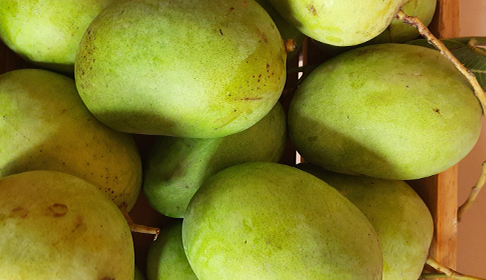
Mango (Mangifera indica) is native to South Asia, more precisely to eastern India and Burma, and is deeply rooted into the Nepali culture. The leaves, bark, seeds, and fruits of the mango tree have been used for cultural and religious rituals, auspicious offering, as well as in traditional medicine for centuries. Historical old mango orchards have been maintained in the hills and terai as bagaicha (village gardens), a symbol of social prestige, but are nowadays severely threatened due to conversion to modern orchards.
The mango season in Nepal starts in summer, first with imported fruits from India, later joined by locally produced ones. Fruits stalls are flooded with mangoes of different shapes, colors, and sizes, showing the high genetic diversity. Among mangoes produced in Nepal, those you will find in the market in urban areas are commercial cultivars of Indian origin, whereas local cultivars are unlikely to be found.
Indian cultivars tend to replace local cultivars because they are more lucrative for farmers. This is especially true in the terai and lower hills, where farmers have access to the formal research system that promotes commercial mango cultivation. Some of the noteworthy cultivars are the very high quality and expensive Alfonso, the bright yellow-orange early maturing Bombay yellow, the elongated fibreless Dashehari, or the more common and beloved Maldaha.
Local cultivars are mostly found in village orchards and sacred grooves, along riverbanks and forest edges. They adapt better to dry and marginal lands, to higher altitude, and are grown for fruits, as well as fodder, fuelwood, and shade purposes. Farmers have given them precise and peculiar names, in their own language, a manner for them to maintain their cultivars distinct from others. The most popular, found in the low hills and terai, are Supare (a small fruit with a betel-nut shape) and Lahare (a cluster of chained fruits). Local mangoes are used in many ways in traditional cuisines of the terai and mid-hills. For instance, green mangoes are grounded into a condiment named Amchurna. The ripe pulp is cooked, spread and sun-dried to make Maadaa, a chewy fruit leather, an ancient method of preserving fruits. Peeled, sliced green mangoes are mixed with salt and spices to make a popular chutney and the sweet Jarmale of terai is used as a salad or pickle.
Where to get mangoes produced in Nepal
- Ask your local vendors! Many of them do have Nepali mangoes, sold side by side with Indian ones.
- Green Growth
- Kathmandu Organics
- Many food shops and brands focusing on selling local and organic produces have popped up around the city